Showing posts with label Lost Classics. Show all posts

Monday, March 01, 2010

Blackeyed Susan's Electric Rattlebone CD review

After parting company with Britny Fox, frontman Dean Davidson launched his solo career with this 1991 effort. Electric Rattlebone was an homage to the Americana roots of rock & roll that aimed for a Black Crowes/vintage Rolling Stones kind of appeal. Below are just a few highlights of this unique album.

"Satisfaction"

After the juke joint jam of the album's self-titled intro, the first proper song we get is an E Street Band-like jubilee with horns, parlor piano and plenty of backbeat attitude.

Gone are the throat-straining vocals of the Britny Fox days. Davidson shows off a more realistic vocal style that doesn't sound like he's trying to achieve any sound other than his own natural timbre.

"None of It Matters"

This is by far the most unique track on Electric Rattlebone with Indian influences like that opening sitar riff, the guru chants peppered throughout and some orchestral overtones on the outro.

Fortunately, Davidson never loses sight of catchy pop hooks. Think of it as the Sgt. Pepper's moment of Electric Rattlebone. Also notable is a brief return of Davidson's over-driven Britny-style vocals at around 3:25 and elsewhere in the track.

"Ride With Me"

Here's a song that was, in a sense, ahead of its time. Pedal steel guitar mixed into the power ballad format predates the hair metal-country crossover by what, 10 years at least? "Ride With Me" is the most beautiful ballad on the album, and it wouldn't be out of place on commercial country radio in 2010.

"Best of Friends"

Almost like a companion piece to "Ride With Me," "Best of Friends" opens with a familiar sounding arpeggio that has definite shades of Cinderella. Beautifully moving piano lines, strong backing gospel-style vocals and a dedication to late founding Britny Fox drummer Tony "Stix" Destra makes this the most poignant track on the record.

"Heart of the City"

Davidson's tribute to his beloved Philadelphia. Heavily electrified slide guitar, clinking cowbell and an instantaneous groove that could make the most leaden footed among us move. Again, a touch of the rough-and-tough Britny-sounding vocals are punctuated throughout for added emphasis. A perfect end to an often overlooked album.

Thursday, September 14, 2006

Lost Classics: Nelson

The Timotei Twins Strike Again!
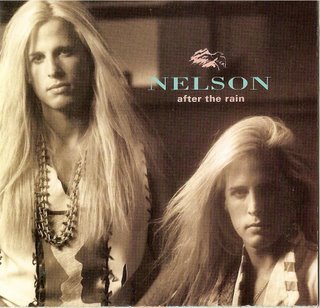

Nelson, After the Rain (Geffen, 1990)

The Big Idea: The spawn of a late teen pop star churn out fluffy pop metal

Choice Cuts: "(Can't Live Without Your) Love and Affection," "After the Rain" and "Tracy's Song/Only Time Will Tell"

Sonic Brethren: Winger, Bon Jovi, Slaughter

First off, let me say that I know this is a much maligned album. However, I believe it's one of the stronger efforts in the commercial metal genre. If you like your metal with pop hooks, Nelson are a sure bet. Consider the band's pedigree for a moment. As the twin sons of '50s teen star Ricky Nelson, singer/bassist Matthew and singer/guitarist Gunnar had ample opportunity to study up on pop songwriting from their father's catalog of hits, which included "Travelin' Man," "Poor Little Fool," "Garden Party" and more.

But while their old man's connections may have helped them secure a record deal, Matthew and Gunnar's music succeeded on much more than nepotism alone. The material on their After the Rain debut married a strong Top 40 vocal presence with pop-metal production values and blazing guitar solos courtesy of Bret Garsed. And let's not forget the role their image played in their initial success -- those boyish faces framed by straight blonde hair earned them the nickname the Timotei Twins in the European press (after a popular Swedish shampoo that featured a female look-alike in its commercials).

The band's first single, "(Can't Live Without Your) Love and Affection," builds from a beautiful acoustic guitar pattern topped by the brothers' mellifluous vocals into a pop confection with sugary hooks. I'd say 'saccharine hooks,' but the connotation is disingenuous. Call me a fool, but I find Nelson believable when they perform their songs. This tune, which topped the Billboard Hot 100 chart in 1990, is said to have been developed from a riff Matthew came up with while looking at a photo of Cindy Crawford in Vogue magazine.
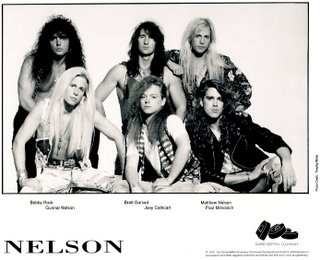
Meanwhile, the disc's title track benefits from sparkling keyboard flourishes courtesy of piano man Paul Mirkovich, additional vocal and instrumental expertise from six-stringer Joey Cathcart and a rock steady groove laid down by ex-Vinnie Vincent Invasion drummer Bobby Rock. While "After the Rain" is a mid-tempo rocker, "Only Time Will Tell" is a true power ballad in every way: Mirkovich dominates with a piano-based arrangement; the hook kicks in with a swooning string section; and the tune is even preceded by a classical guitar intro titled "Tracy's Song" in honor of Matthew and Gunnar's sister Tracy. Need a quick primer on every glib power ballad cliché in the book? Look no further than "Only Time Will Tell." But that's precisely why we love the Timotei Twins -- they give their fans what they want.

I believe Nelson fans suffer from the same affliction that strikes Spice Girls or New Kids on the Block lovers: Though these are all multiplatinum acts, you can't find a single person who'll fess up to having bought a copy. Well, I'm proudly announcing myself as a Nelson fan and consumer, albeit 16 years too late. (Though I would never pay full price. I found After the Rain used for $1 at a local record shop!)

Thursday, August 17, 2006

Lost Classics: Britny Fox

Good Old Boys Revisited


When Britny Fox burst onto the scene in 1988 with their self-titled debut, they immediately garnered a lot of attention for their decadent Victorian glam look and back-to-basics AC/DC-inspired songwriting. Britny Fox nearly hit the platinum mark thanks to singles like “Girlschool,” “Long Way to Love” and “Save the Weak.” The early Britny sound was defined by leather-throated singer/guitarist “Dizzy” Dean Davidson leading the way over the tuneful riffs of onetime Cinderella guitarist Michael Kelly Smith.

Britny Fox was, of course, shear genius. Yet the Philadelphia hair-metal act wasn’t able to sustain the initial success. The Fox’s 1989 sophomore effort, Boys in Heat, boasted a tougher, more balanced approach to songwriting, but it never translated into commercial success. All of which definitely qualifies Boys as a lost classic.

The sound of a revving motorcycle screeching off into the distance opens “In Motion,” the disc’s first cut. It’s a track designed to really entice you in as a listener, with drummer Johnny Dee’s double-time chops and Davidson’s triple-time motor-mouth delivery evoking the hectic pace of the rock & roll lifestyle. Surer, steadier grooves follow in “Standing in the Shadows” and “Hair of the Dog” - thanks to the rock-steady playing of bassist Billy Childs. The latter song is, of course, a brilliant cover of the Nazareth classic. It continues in the footsteps of Britny’s version of Slade’s “Gudby T’Jane” on Britny Fox. Power-balladry dominates on “Dream On,” while tracks like “Long Way From Home,” “Shine On” and “Angel in My Heart” offer just the right combination of gritty mess and radio-friendly finesse.

In an interesting coincidence, Boys also found Britny shedding their signature sartorial look in favor of a denim-and-leather wardrobe. Perhaps because clothes were so closely associated with the band, they lost a sizable portion of their fan base when they took the haute couture leap. What a pity. Their sophomore effort is a quality one.

Tuesday, August 15, 2006

Lost Classics: YLD

Just Like Fools Paradise

Of all the great acts the ‘80s gave us, I have a particular soft spot in my heart for those that never really made it. Everybody has a favorite "wannabe" band, whether they want to admit it or not - you know, those third-tier talents that put out ragged little releases that were wholly ignored. Yet the heart and soul those maligned acts poured into their music lives on long after their chances at commercial success have died. Many bands fit this bill, but one of my personal favorites is YLD (pronounced “wild,” their name is written with a line over the “Y”).

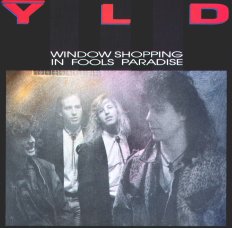
In 1989, the quartet released its debut (and only?) album, Window Shopping in Fools Paradise, on the Absolute Records imprint. If you look closely at the cover, you’ll see that at least two of the band’s members are clearly wearing bolo ties – could it be that they hail from the Southwestern United States? We may never know. Here’s another brainteaser: While bands like Motörhead, Mötley Crüe, Queensrÿche and others used the umlaut to signify a menacing, Germanic quality, what are we to make of YLD’s diacritical mark of choice? Is it intended as a sort of Anglicized tilda to give the band’s name a vaguely Hispanic feel while still remaining firmly Anglo?

Enough about the album cover – let’s get down to YLD’s unique brand of bolo boogie. “Wild Girls” starts the album off in raucous style with frontman Kevin Mier Mellenbruch turning in a love-it-or-leave-it vocal performance that falls somewhere between Accept’s Udo Dirkschneider and Britny Fox’s “Dizzy” Dean Davidson. The band’s lumbering yet oddly invigorating stab at Led Zeppelin’s “Good Times Bad Times” follows, but Window Shopping doesn’t really get cooking until “The Distance.” This track is marked by vocal-driven, pop-indebted songwriting and guitarist James Bengston’s eager soloing, which conjures up shades of early Vito Bratta.

The album’s centerpiece is an uplifting cut called “Music Music” that pays tribute to the hardships and victories of life in a struggling band. Opening with a Bengston lead that sounds like an outtake from a lost ‘80s teenage flick, “Music Music” is saturated with tasty six-string escapades and heart-on-the-sleeve lyrics. When Mellenbruch sings, “On a skeleton crew, doing the graveyard shift/I was going nowhere/I took my MDR/of rock and roll/My radio blast/Guitar in hand/I lose control,” you just know he’s lived those lyrics. Call it cheesy if you must, but you can’t take the man’s honesty away from him.

Could YLD ever have made it big under different circumstances? Probably not. But I maintain that it's the C-list talents who really make the ‘80s metal world go round. After all, where would the megastars be without all the wannabes clamoring at their feet?

Tuesday, August 08, 2006

Lost Classics: Spread Eagle


Though rap and hip-hop are today synonymous with urban music, New York-based Spread Eagle were one of a handful of heavy metal acts who accurately depicted the grime and crime of city living more than a decade ago. The seedy songwriting and melodic metal riffs of their 1990 self-titled disc did a lot to raise their profile as the Big Apple’s answer to early Guns N’ Roses.

While Spread Eagle wasn’t an unabashed success in its day, it’s since been labeled a ‘classic’ by headbangers everywhere. However, the band’s follow-up, 1993's Open to the Public, is often criminally overlooked. With the recent news of the group’s upcoming reunion tour, it’s a good time to take a look back at Spread Eagle's underrated sophomore effort.

The songwriting on Public is less gritty and perhaps less focused than on its predecessor, yet it’s more expansive. Guitarist Paul DiBartolo ditches excess distortion in favor of clean electric tones on several songs, including “Fade Away” and “High Horses.” Meanwhile, frontman Ray West—noted for his usually bleak, nihilistic tales—gets an attitude adjustment on tracks like “Shine” and “Faith,” which find him exploring relationships and the lighter side of life. The latter track, in fact, is the real standout here with its warm Hammond B3 organ tones and gospel-inspired vocals. It's a perfect way to end the album.
One caveat about “Faith”: Despite the title, it is not a religious song. Instead it’s an upbeat paean to the dreamers of the world who transcend ugly reality. The refrain includes the lyrics, “Faith is gonna set me free/Faith is gonna let me be/When everything is falling down on me now/Well I sit here and dream, well I set myself free.” West & Co. craft the song with an uncommon attention to melody and detail, giving it all the emotion and beauty of a Motown ballad. It’s a fitting final statement from these gritty Big Apple rockers with even bigger hearts.

Note: See below to enter to win an autographed photo of Iron Maiden frontman Bruce Dickinson!

Wednesday, August 02, 2006

Lost Classics: House of Lords

The first review in a series dedicated to forgotten classics of the genre

House of Lords were the first act signed to Gene Simmons’ Simmons Records imprint and released their self-titled debut in 1988. The Kiss singer-bassist’s relationship with HOL keyboardist Gregg Giuffria dates back to the ‘70s when the latter was a member of Angel. Simmons discovered Giuffria's proto-hair metal act and got them signed to Casablanca Records. The shared history between the two men made for a great working relationship on House of Lords; the album is a fine, albeit forgotten platter from the heady days of the hair-metal revolution. Simmons serves as executive producer on the disc.

“Pleasure Palace” kicks the album off in a regal style befitting the House of Lords name. An extended keyboard intro announces the major role Giuffria plays in this quintet, while guitarist Lanny Cordola vies with him for primacy by squeezing nasty pinch harmonics out of his axe during the tune’s catchy refrain. The most overtly commercial moment on House of Lords follows with “I Wanna Be Loved.” A natural choice for a single, this song boasts a huge, vocally driven “woah, woah, woah-a-woah” chorus and verses in the Whitesnake vein, with frontman James Christian at his sultry best.

House of Lords is dominated by two types of songs: mid-tempo keyboard-driven numbers that show off the band’s dramatic instincts and go-for-the-throat shred fests that spotlight Cordola’s inspired fretsmanship. In the former category we have slower, deeply thespian numbers like “Edge of Your Life,” “Love Don’t Lie” and “Jealous Hearts.” Falling into the latter group are relentless riffers such as “Slip of the Tongue” (Whitesnake anyone?!) and “Lookin’ for Strange,” which features a boozy, barroom piano intro that can’t obscure the fact that it’s the hardest-rocking track on the disc.

Other album highlights include two amazingly anthemic tunes: “Under Blues Skies” and “Call My Name.” In both theme and sound, “Under Blue Skies” loosely fits with Van Halen’s “Dreams” and Steve Stevens’ “Top Gun Anthem” in a sort of triumvirate of ‘80s rockers written about the joys of flight and other uplifting experiences.